

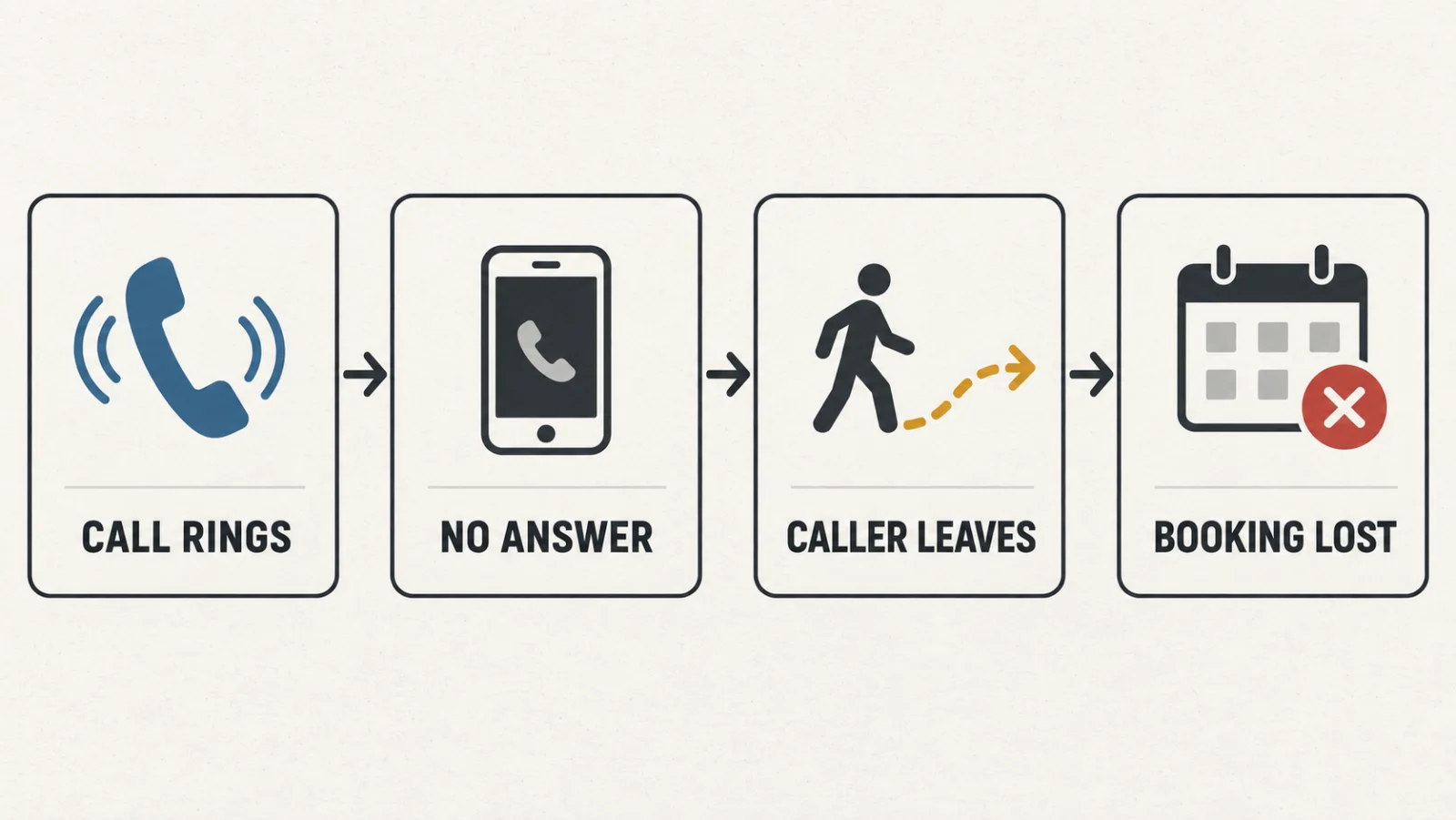
Every service business has the same quiet leak. The phone rings during the dinner rush, mid-job, or after hours. Nobody picks up. The caller does not leave a voicemail — they call the next business on the list. By the time you check missed calls in the evening, the job is gone, and no quote ever happens. This is not a marketing problem. It is an answering problem, and it is the first thing worth fixing before spending another dollar on demand.
Make the leak visible
A missed call is not one failure. It is a short chain: the phone rings, the business cannot answer, the caller moves on, and the open slot disappears from the calendar. Naming the chain makes the intervention easier to scope. You do not need to automate every customer conversation; you need to keep a routine inquiry from dying before anyone can qualify it.
An AI receptionist earns its place by doing four jobs in order. First, it answers every call on the first rings, including evenings, weekends, and the rush you cannot staff for. Speed is the whole point: a caller who waits is a caller who leaves. Second, it captures the booking, not just a message. Name, callback number, what they need, when they need it, and a time window that works — structured the same way every time, so nothing depends on anyone's memory or handwriting. Third, it follows up. The estimate gets confirmed by text, the appointment gets a reminder the day before, and the no-show rate falls because the customer was never left guessing. Fourth, it knows when to hand over. A price dispute, an upset customer, a request outside the script — those go to a human immediately, with the call notes attached, instead of trapping the caller in a loop.
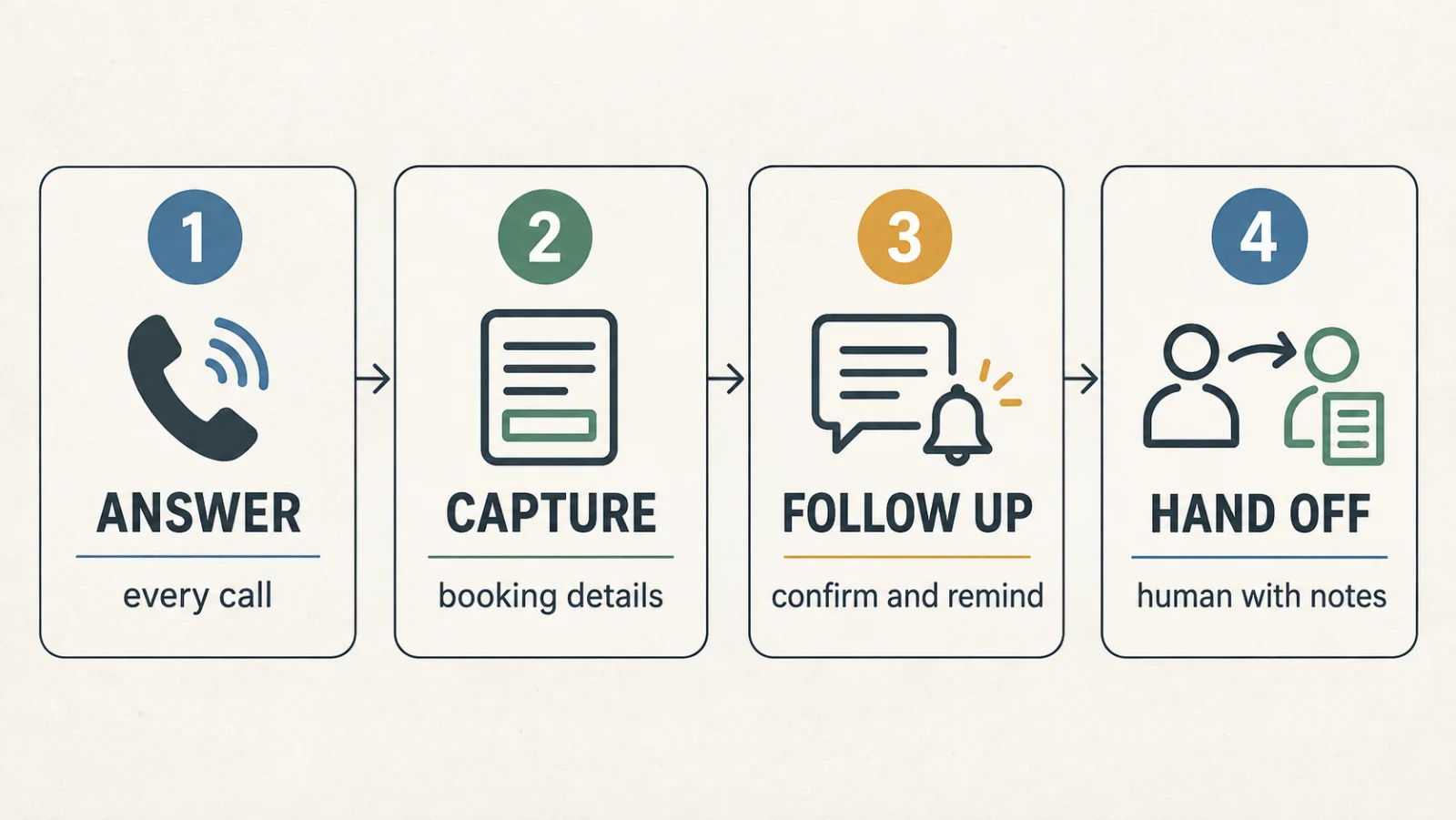
The sequence matters. A handler that answers quickly but records only “call me back” has preserved the interruption, not the opportunity. A handler that collects a perfect intake but never confirms the next step leaves the customer in the same uncertainty. Treat the four jobs as one handoff: answer the call, create a useful booking record, keep the next step visible, and give a person enough context to take over when the call stops being routine.
A booking is a small operational record
Take a simple after-hours repair inquiry. The caller wants a quote next week. A useful handler identifies itself as automated, asks for the caller's name and callback number, captures the type of repair, records urgency and preferred time window, and repeats the details back. If the request fits the supplied service rules, it can propose the next booking step and send a confirmation. The morning review then starts with a structured record rather than a vague voicemail.
That record should be designed around what the team will actually use. Keep the questions short enough for a caller to answer naturally, but specific enough that the person taking the job can decide what happens next. If a field is not used by the scheduler, estimator, or technician, it probably does not belong in the first version. The goal is not to collect a transcript. It is to turn an interrupted call into work someone can see and act on.
The trust boundary matters
What it must never do matters as much. It must say it is automated when asked, never pretend to be the owner, and never invent prices, availability, or promises the business cannot keep. Every commitment it makes — a time, a price range, a callback — has to come from information the business actually supplied. A receptionist that hallucinates a discount is worse than a missed call, because now someone has to un-promise it.
The handoff rule should be visible before launch. Routine inquiries with known answers can stay in the automated path. A complaint, price dispute, request outside the script, or situation that needs judgment should move to a human with the notes attached. When the handler cannot establish that a commitment is allowed, uncertainty is itself a reason to escalate.

This boundary also keeps the scope honest. An AI receptionist is not a replacement for judgment, and it is not a reason to hide the fact that a person may take over. It is a way to cover predictable calls during the hours when the front desk is busy, closed, or already helping someone else.
The honest fit test
The fit test is short. If most of your inbound calls are new inquiries, bookings, and confirmations with a predictable shape, automation covers the bulk of them well. If most calls are complex complaints, negotiations, or emergencies that need judgment, the AI should only take the message and escalate fast. Restaurants, clinics, trades, and rental counters usually land in the first group during peak hours and after closing; that is exactly where the leak is biggest.
Do not decide from the industry label alone. Look at the calls. For a week, sort missed calls and answered calls into routine inquiry, booking or confirmation, exception, and unknown. Note which details the team asks for every time and which conversations require a person. The result is a better first script than a feature list because it is based on the work the business is already trying to complete.
Start with overflow, then widen coverage
Getting started does not require rebuilding the phone system. Point after-hours and overflow calls at the handler first, review the captured bookings each morning for two weeks, tighten the questions it asks, and only then widen coverage. The metric that matters is recovered bookings — jobs that would have been missed calls and turned into scheduled work instead.
Use the first two weeks as an operating review, not as a victory lap. Each morning:
- Compare captured booking details with the calendar or job queue.
- Mark whether the next step was clear, missing, or handed to a person.
- Remove a question that did not help the team act.
- Add an escalation rule when a call exposed a judgment the script cannot safely make.
- Check that confirmations and reminders match the business information supplied to the handler.
That loop improves the system without widening its authority by accident. Once routine coverage is dependable, expand one time window or call type at a time and keep the same review discipline.
We build AI call handling for service businesses at CodeAustral. Start with the CallTurbo entry in our portfolio for a current example of our work, then send a brief describing your call volume and peak hours. For a wider view of managed AI operations, see AI Employees. Related reading includes our restaurant technology integration roadmap for fitting call handling into a wider stack, and where AI agents actually work in internal operations.